Mar 9, 2026
The advantages of VALL prefabricated buildings for the aeronautical industry make them the ideal solution to meet the temporary or permanent space needs of companies in a rapidly growing sector. The aeronautical industry requires solutions to robustly and promptly address the increasing demand for passenger, freight, and defense aircraft, as well as the high demand for aircraft maintenance, overhaul, and repair, which, specifically for engines, exceeded 50% last year compared to the previous year. With this data, the need for adequate spaces for manufacturing parts and components for the sector, as well as for their assembly and testing, becomes evident. At VALL, we manufacture textile-clad metal prefabricated buildings whose advantages for the aeronautical industrial sector are obvious, and here we will show them to you clearly and transparently.
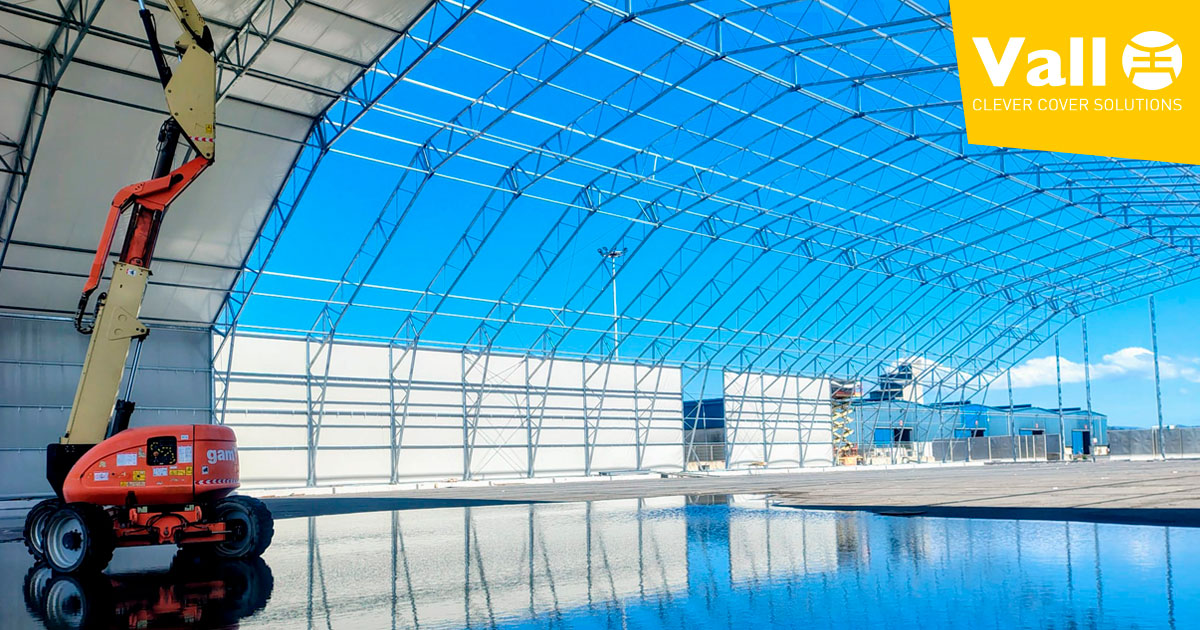
The aeronautical industry needs airplane hangars, component manufacturing buildings, and large-scale workshops with clear spaces, without obstacles such as beams, columns, or trusses. They require the appropriate clearance and height so that airplanes or large parts, equipment, and machinery can fit and work at full capacity without hindrance. At VALL, you can find a great diversity of suitable solutions, including metal hangars and large demountable steel industrial buildings that are completely clear, even in height, from which to choose the right one for your company.

 https://www.iba.aero/resources/articles/2026-predictions/
https://www.pwc.ie/media-centre/press-releases/2026/global-aviation-outlook-2026.html
https://industria.gob.es/es-es/Servicios/AgendasSectoriales/Agenda%20sectorial%20de%20la%20industria%20aeron%C3%A1utica/Agenda-sectorial-industria-aeronautica.pdf
https://cordis.europa.eu/article/id/88438-aerospace-advancement-for-the-entire-eu/es
https://aviationbenefits.org/other-environmental-challenges/quantifying-aviations-climate-impact/
https://www.iea.org/energy-system/transport/aviation
Efficient spaces: large buildings without internal obstacles.
Tightness and efficiency that guarantee proper environmental protection.
The aeronautical industry needs to have a controlled working environment that meets the appropriate conditions to guarantee the protection of equipment, devices, and components, which in many cases are precision items and need a clean environment, free of dust and suspended residues, and with a rigorous and constant temperature range for their manufacture, storage, or repair. The advantages of VALL prefabricated buildings for environmental protection are evident. We offer the possibility to acquire for rent or purchase prefabricated buildings with canvas covers featuring the TWS system that guarantee excellent watertightness and prevent condensation, protecting equipment and devices from humidity. The advantages of prefabricated buildings with the TWS system are highly relevant. They are efficient buildings that make it easier and cheaper to maintain the constant temperature and controlled humidity required to prevent corrosion and deterioration of sensitive materials and components.Speed, versatility, and flexibility, three advantages of VALL prefabricated buildings for the aeronautical industry.
One of the challenges currently facing the aeronautical industry is manufacturing bottlenecks. One of the advantages of VALL prefabricated buildings to overcome this is their agile installation, with operability in a short time and the capacity to provide a solution to the urgent, temporary, or permanent workspace needs of companies, while keeping costs controlled.
Efficient and sustainable buildings that contribute to reducing the company's carbon footprint.
Another major challenge for the aeronautical sector is the reduction of emissions and the carbon footprint in all areas and processes involved in its work. For example, the EU aims to reduce CO2 emissions in aviation by 65% by 2050. In this regard, any business decision that helps meet this objective makes these companies more competitive, contributes to improving their public image, and increases their future opportunities. Our efficient prefabricated buildings are a support in this regard. Reducing the company's carbon footprint with the help of demountable buildings is a real possibility to consider. Furthermore, the sustainability of industrial buildings helps companies in the sector become greener, improving their environmental respect.Resistance and security.
VALL prefabricated buildings are steel or aluminum structures that are designed, manufactured, and assembled to comply with the strict norms EN 13782, EN 1090, and Eurocodes, providing protection and safety for aircraft, equipment, components, and personnel. They are solid, durable, and highly resistant solutions. Their structural safety and stability are maximum.Efficiency and durability: advantages of VALL prefabricated buildings for the aeronautical industry sector that translate into savings and sustainability.
The savings enabled by VALL prefabricated buildings are a highlight. They can be acquired for purchase or rent for temporary or permanent use, offering a variety of profitable options that allow each company to make the most beneficial decision for its interests. Their rapid assembly with a significant reduction in costs and waiting times for permits compared to traditional construction, and their minimal maintenance needs, contribute to their quick return on investment. In addition, they are efficient and sustainable solutions that reduce energy consumption needs to maintain an adequate controlled temperature for the most sensitive components and to provide comfortable and safe working conditions for the workforce. And that also means a significant reduction in costs throughout their long useful life. Contact us to request a quote and a member of our technical department will assist you as soon as possible.
Sources
https://www.pwc.ie/media-centre/press-releases/2026/global-aviation-outlook-2026.html
https://industria.gob.es/es-es/Servicios/AgendasSectoriales/Agenda%20sectorial%20de%20la%20industria%20aeron%C3%A1utica/Agenda-sectorial-industria-aeronautica.pdf
https://cordis.europa.eu/article/id/88438-aerospace-advancement-for-the-entire-eu/es
https://aviationbenefits.org/other-environmental-challenges/quantifying-aviations-climate-impact/
https://www.iea.org/energy-system/transport/aviation
Table of contents
- Tightness and efficiency that guarantee proper environmental protection.
- Speed, versatility, and flexibility, three advantages of VALL prefabricated buildings for the aeronautical industry.
- Efficient and sustainable buildings that contribute to reducing the company's carbon footprint.
- Resistance and security.
- Efficiency and durability: advantages of VALL prefabricated buildings for the aeronautical industry sector that translate into savings and sustainability.