May 11, 2026
The advantages of prefabricated industrial buildings in global uncertainty scenarios, compared with conventional construction, are clear in areas such as financial cost, speed of commissioning, adaptability to change and capital protection.
The current global outlook is marked by a high level of uncertainty. This is driven by factors such as geopolitical instability, disruptions in supply chains, price volatility, changes in international transport routes, economic protectionism and the increasing risk of natural disasters linked to climate change.
In this context, companies are prioritising resilience, adaptability and capital protection in their strategic decisions. For this reason, the characteristics of prefabricated industrial buildings make them an especially beneficial solution for companies that need facilities that are fast, efficient, safe and flexible.
At VALL, with more than 30 years of experience in the design, manufacturing and assembly of prefabricated industrial buildings, we know how these solutions help companies through their financial, structural and operational advantages.
Advantages of prefabricated industrial buildings in global uncertainty scenarios
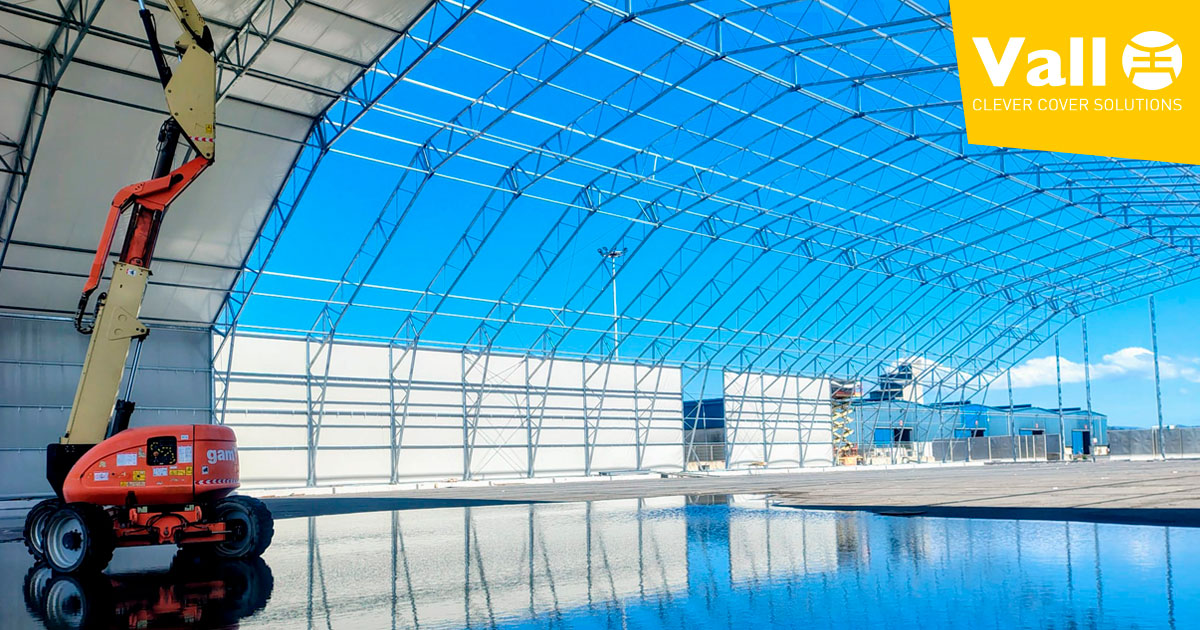
Prefabricated industrial buildings provide a fast, cost-effective and flexible response in a context where companies must make agile decisions and reduce risk. Compared with conventional construction, they make it possible to have operational facilities in less time, with greater cost control and a much higher capacity for adaptation.
They are especially suitable for companies that need to expand production capacity, increase storage space, create new logistics areas, protect goods or machinery, or respond to temporary or permanent operational needs without committing to slow and rigid construction processes.
Fast installation and commissioning of prefabricated industrial buildings
When a company needs facilities in a specific location, the speed with which that space can become operational is essential. Prefabricated industrial buildings offer the advantage of very fast installation and commissioning.
This is possible thanks to several factors:
- Shorter manufacturing and assembly times.
- No need for foundations in many projects.
- Reduced permit requirements, which can considerably shorten waiting times.
- Parallel manufacturing while the site is being prepared.
- Production of components in a controlled environment, reducing the risk of unforeseen events.
- Industrialised processes that help ensure precision, quality and reliability.
This speed also offers a significant financial advantage for companies. By reducing downtime, the company can move forward more quickly with its operations and obtain a faster return on investment.
In uncertain contexts, this ability to respond quickly can become a decisive competitive advantage. Companies can adapt to new demand, open new operational areas or reinforce existing facilities without the long lead times associated with traditional construction.
Cost savings and reduced financial risk for companies
Capital protection is key in a scenario of global uncertainty. Installing prefabricated industrial buildings represents significant savings and a major reduction of financial risk compared with conventional construction.
The main advantages are:
- Lower costs thanks to factory automation, material optimisation and reduced labour requirements during assembly, among other factors.
- Fixed prices with no cost variation, avoiding the financial risks associated with slow conventional construction in a context of price volatility, inflation and rising fuel and material costs.
- High durability and minimal maintenance costs: steel industrial buildings are safe, resistant and durable. This increases resilience, including in situations involving natural disasters, which are becoming more frequent due to climate change.
- Lower impact on daily operations, as installation is faster, cleaner and less invasive than traditional construction.
At VALL, we also offer the possibility to choose between rent or purchase, helping each company select the option that best fits its operational and financial needs.
This flexibility is particularly valuable for companies that need to preserve liquidity, avoid unnecessary long-term investments or respond to temporary peaks in activity without compromising future growth.
Adaptability to change and versatility of use
Adaptability and versatility are two key values for business flexibility and resilience in uncertain global scenarios.
VALL metal-textile industrial buildings offer the flexibility companies need to respond to the requirements of each moment in constantly changing markets.
Their advantages include:
- Possibility of relocation. Our removable industrial buildings, industrial tents, metal-textile industrial buildings and steel or aluminium structures are reusable solutions. They can be dismantled and reassembled in the desired location, offering significant opportunities for adaptation.
- Modularity and size changes. Demountable modular buildings can be expanded or reduced easily through fast and safe reconfiguration.
- Simple interior reorganisation. Although they are designed as open-plan prefabricated buildings with excellent space optimisation, they can be divided quickly to achieve a layout adapted to each company's needs.
- Versatility of use. They can be used as logistics buildings, production buildings, office spaces, distribution centres, commercial areas, warehouse buildings, or quality control and testing zones, among many other uses.
- Adaptation to temporary or permanent needs. Industrial tents, steel buildings and Prefabricated Modular Building solutions can respond to urgent operational requirements while also serving as long-term infrastructure solutions.
This versatility allows companies to make decisions with greater confidence. Instead of investing in fixed facilities that may become obsolete or insufficient, they can rely on adaptable space solutions that evolve with the business.
Efficiency and sustainability of prefabricated industrial buildings
The energy efficiency of prefabricated industrial buildings is especially important in uncertainty scenarios, due to its direct impact on cost savings, sustainability and operational safety.
Their main benefits include:
- Lower energy consumption needs, which translate into significant cost savings. This is particularly relevant for business profitability in a context of volatility and high inflation in energy prices.
- Contribution to the reduction of the carbon footprint and to companies' commitment to sustainability and the fight against climate change.
- Better protection for machinery by maintaining a safer and more comfortable temperature range, reducing preventive stoppages caused by the risk of overheating equipment or devices.
- Stronger environmental commitment and corporate image, an important factor for resilience in today's complex and unstable market.
- Improved comfort, hygiene and health conditions in workspaces, contributing to greater worker safety and reducing absences or problems caused by inadequate conditions.
- Reduced construction waste compared with traditional building processes, thanks to industrialised manufacturing and material optimisation.
Energy efficiency is therefore a strategic factor for companies looking for cost-effective, safe and sustainable facilities.
Prefabricated industrial buildings also support circular economy principles. Many of their components can be reused, relocated or adapted to new requirements, extending their useful life and reducing the need for new materials.
A solution for resilient and sustainable construction
On the path towards resilient and sustainable construction, prefabricated industrial buildings are cost-effective, safe and efficient solutions. These values are essential for companies that need to make decisions in current and future contexts of instability and uncertainty.
Their speed of assembly, adaptability, controlled costs, durability and energy efficiency make prefabricated industrial buildings an especially suitable alternative for companies that need to protect their investment without giving up operational flexibility.
In a global environment where supply chains, markets and costs can change rapidly, having a flexible and scalable industrial infrastructure is a strategic advantage. Prefabricated industrial buildings allow companies to respond quickly, reduce exposure to risk and maintain operational continuity.
Contact us to request a personalised quote and our technical team will help you find the most suitable solution for your company.

Sources
https://www.mapfreglobalrisks.com/en/risks-insurance-management/topicality/change-and-uncertainty-anatomy-of-global-risks/
https://www.lanacion.com.py/negocios_edicion_impresa/2025/06/23/escenario-de-incertidumbre-mundial-obliga-a-la-resiliencia-de-economias/
https://www.camarabilbao.com/empresa/internacionalizacion/tiempos-incertidumbre-mas-mercados-menos-riesgos-202604071613/
https://transitosdelestrecho.com/impacto-geopolitica-transporte-mercancias/
Table of contents
- Advantages of prefabricated industrial buildings in global uncertainty scenarios
- Fast installation and commissioning of prefabricated industrial buildings
- Cost savings and reduced financial risk for companies
- Adaptability to change and versatility of use
- Efficiency and sustainability of prefabricated industrial buildings
- A solution for resilient and sustainable construction