


Sep 8, 2026
The industry of the future will be flexible, making it essential for industrial spaces to start preparing now. They will need to adapt easily to the changes ahead, both those that are already clearly visible and those that have yet to be defined.
Industrial buildings of the future will need to be living spaces:
- Adaptable.
- Dynamic.
- Efficient.
- Sustainable.
- Highly technology-enabled.
Why will the industry of the future be flexible?
Recent years have already shown that markets, geopolitics and technological change can be unpredictable. The business environment will become increasingly changeable, competitive and uncertain over the medium and long term, so industry will need to take this into account and be ready.
Incidents, adverse climate events and changes in customers' lifestyles can occur without warning. Industry must therefore be adaptable, flexible and resilient in every situation and across every department.
What flexibility means for the industry of the future and its industrial spaces
The changes are far-reaching and call for equally significant measures:
- Flexible production and logistics, always ready for the changes a company may need at any time, while maintaining profitability and brand values through dynamic stock management, picking optimisation and opportunities for operational scalability.
- Intelligent automation and centralised software capable of reprogramming the routes followed by industrial robots in real time.
- Mass customisation driven by differentiation, a key factor for business success in a highly competitive environment.
- Resilience throughout the company, from production and logistics to marketing and sales, in constantly changing markets and economic and geopolitical settings.
- Efficient use of resources, with spaces and machinery able to perform several functions, reduce costs and minimise energy use and environmental impact.
- Constant changes in demand, which make prefabricated industrial buildings essential for a rapid response, automatic scalability and operational resilience.
- Adapting production, logistics and growth strategies to real-time demand, prioritising on-demand and adaptive production.
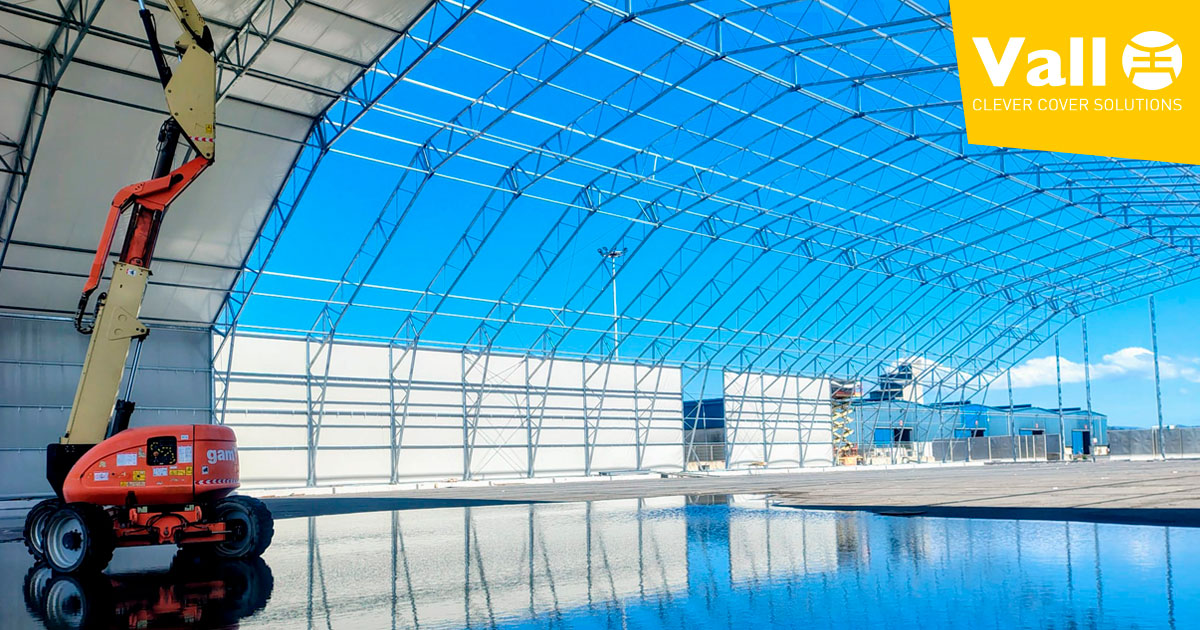
Industrial facilities prepared for the changing needs of flexible industry
The main requirements and solutions include:
- Spaces prepared for automation, including open-plan industrial buildings for automated logistics, automated guided vehicles, autonomous mobile robots and collaborative robotics.
- Enough space to modify production lines immediately so that precisely what is needed can be manufactured.
- Modular buildings for logistics and production that are also demountable industrial buildings, can be modified and can be put into operation quickly.
- Replacing traditional assembly lines with independent work cells.
- Optimising floorspace for integrated logistics and a continuous flow of goods, so that manufacturing and storage areas are fully interconnected or even form a single dual-purpose space.
- Open-plan prefabricated buildings whose open design can be adapted within a very small number of hours, simply and cost-effectively.
- Maximum customisation, with bespoke accessories for each industrial space, such as versatile loading bays that can serve different types of vehicle as transport needs change with demand.
- Digital twins with live connections and advanced simulation, allowing companies to adapt efficiently to changing demand without putting real production at risk.
- A strategic location that allows change without compromising current distribution operations.
- Avoiding rigid contracts and prioritising adaptable solutions, such as rental models for industrial facilities, machinery and furniture.
How industrial spaces are changing for the flexible industry of the future
It is already possible to prepare for the flexibility the industry of the future will require.
Modular spaces
Designs with large open-plan spaces that can be expanded, reduced and easily converted using movable walls and partitions make it possible to reconfigure an industrial space quickly, safely and cost-effectively in order to:
- Take advantage of growth opportunities.
- Adapt quickly to changes in demand.
- Create hybrid areas.
- Reconfigure modular production lines within a few hours.
- Rapidly create areas for specific uses where appropriate, such as shared wellbeing and work areas for staff, optimised testing, quality-control or laboratory spaces, and attractive exhibition and sales areas open to the public.
Versatile furniture and machinery
Wherever a company's needs allow, furniture and machinery should be:
- Multifunctional.
- Mounted on wheels or rails.
- Easy to reconfigure.
- Supported by dynamic self-supporting shelving that facilitates logistics and the work of cobots, or collaborative robots.

SPACE
Efficient, automated and highly technological plug-and-play facilities
- Immersive technology in meeting rooms and areas whose size and function can be adapted.
- Optimised natural lighting and ventilation, supported by solutions such as TWS roofs.
- Comprehensive automation using building management systems (BMS).
- Energy-efficient prefabricated buildings that support intelligent energy management and minimise energy consumption for lighting and climate control.
- Industrial spaces prepared for automation.
- Private 5G networks and IoT sensors.
Contact us to request a quote for a flexible industrial space for your company or to ask any questions. One of our technical sales specialists will provide the information you need.

Sources:
Table of contents
- Why will the industry of the future be flexible?
- What flexibility means for the industry of the future and its industrial spaces
- Industrial facilities prepared for the changing needs of flexible industry
- How industrial spaces are changing for the flexible industry of the future
- Modular spaces
- Versatile furniture and machinery
- Efficient, automated and highly technological plug-and-play facilities


