Oct 9, 2025
Sustainability in logistics is both a challenge and a necessity. Logistics is one of the sectors under close scrutiny by citizens who are aware of the need to reverse climate change and protect the environment. Within the sector, measures are gradually being adopted to reduce the carbon footprint, reach net-zero emissions, and contribute to a cleaner, healthier world.
The carbon footprint in logistics is very high, and the data show it. It is estimated that 15% of global CO2 emissions correspond to the transport and logistics sector. In some regions it is even higher, such as in the EU, where in 2020 27.1% of total emissions were attributed to transport and logistics.
And it's not only the carbon footprint that affects the sustainability and environmental impact of the logistics sector. Waste reduction and the lower use of natural resources, among other issues, are key factors for sustainability in logistics.
Out of corporate responsibility and brand image, movements such as eco-logistics are being adopted by large companies in their aim to be more sustainable—and increasingly by smaller companies as well. Every decision counts when it comes to reducing a company's carbon footprint.
However, without necessarily implementing every criterion of green logistics, there are many decisions logistics companies can make to improve their sustainability, and in them the role of prefabricated buildings is highly relevant.
Every choice or decision counts when striving to be a more sustainable logistics company. In this regard, modular prefabricated buildings for logistics play a fundamental role in improving a company's sustainability.
It's important to keep in mind that some goods must be stored or handled within a specific temperature range and that, for employees, working at a comfortable ambient temperature is key to well-being, improving productivity, and reducing sick leave. Efficient prefabricated buildings reach and maintain comfort temperatures with lower energy consumption for heating and cooling, resulting in a smaller environmental impact and cost savings.
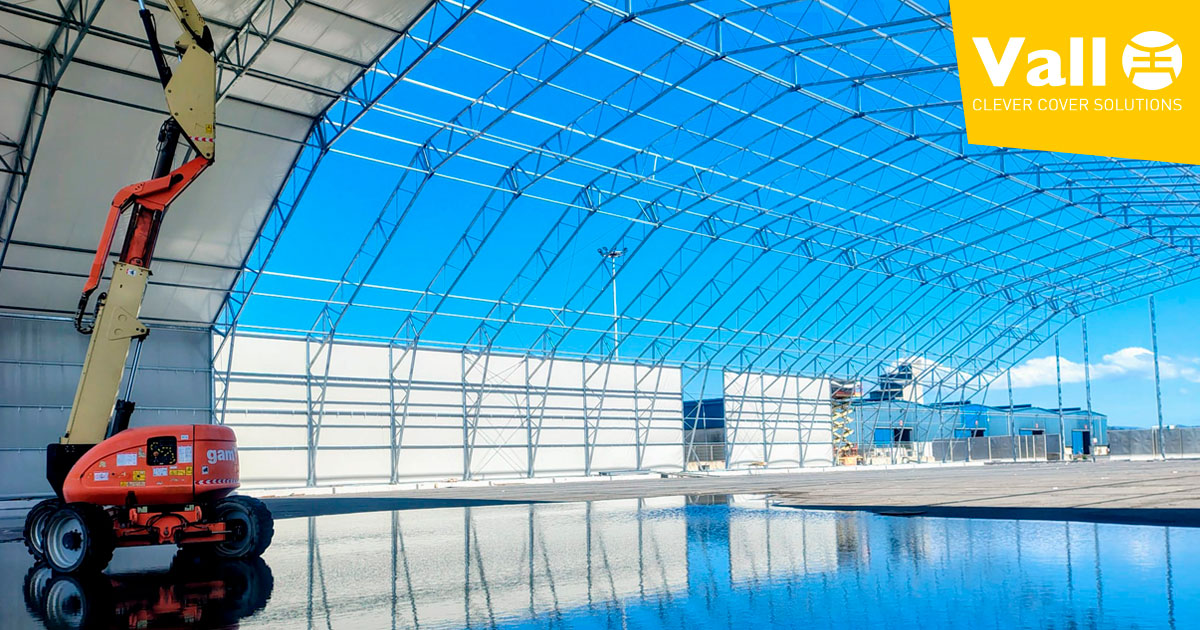
Moreover, energy-efficient industrial buildings and marquees with translucent membrane roofs and enclosures require less energy for lighting during daylight hours.
These buildings are reusable, can be relocated, and have a long service life. Even at the end of life, their environmental impact is low because they hardly generate waste.
At VALL our modular prefabricated buildings have metal structures made of steel or 100% recyclable aluminum. The importance of recycling metals for the environment is enormous and also provides a significant economic advantage.

And not only that. Space optimization, the open-plan design of prefabricated buildings, and vertical utilization make it easier to adopt innovative systems and new technologies that improve productivity and operational efficiency while also contributing to sustainability in logistics.
Examples include automated racking, the use of autonomous vehicles powered by green energy inside the building, other robotic solutions, and AI-driven stock management.
It's important to note that automated systems reduce losses and errors. This results in fewer returns, avoiding the economic and environmental costs of transporting and disposing of returned goods.

That adaptability has a dimension to consider in the field of sustainability, since it allows expanding or downsizing with minimal environmental impact, responsible use of resources, and minimal waste generation. And their long service life also means lower resource use and less waste generation—the opposite of conventional fixed buildings.
 BBVA – What is sustainable logistics?
DHL – Interview on sustainable logistics
Modumaq – Carbon footprint in logistics and how to reduce it
The importance of sustainability in logistics.
And it's not only the carbon footprint that affects the sustainability and environmental impact of the logistics sector. Waste reduction and the lower use of natural resources, among other issues, are key factors for sustainability in logistics.
Out of corporate responsibility and brand image, movements such as eco-logistics are being adopted by large companies in their aim to be more sustainable—and increasingly by smaller companies as well. Every decision counts when it comes to reducing a company's carbon footprint.
However, without necessarily implementing every criterion of green logistics, there are many decisions logistics companies can make to improve their sustainability, and in them the role of prefabricated buildings is highly relevant.
How prefabricated buildings help sustainable logistics.
The energy efficiency of prefabricated buildings and their contribution to sustainable logistics.
Prefabricated buildings with energy efficiency reduce the energy consumption needs of logistics companies for the tasks carried out inside them.It's important to keep in mind that some goods must be stored or handled within a specific temperature range and that, for employees, working at a comfortable ambient temperature is key to well-being, improving productivity, and reducing sick leave. Efficient prefabricated buildings reach and maintain comfort temperatures with lower energy consumption for heating and cooling, resulting in a smaller environmental impact and cost savings.
Moreover, energy-efficient industrial buildings and marquees with translucent membrane roofs and enclosures require less energy for lighting during daylight hours.
Minimal environmental impact of prefabricated buildings during assembly and disassembly.
The environmental impact of constructing a fixed logistics building contrasts with the sustainability and minimal environmental impact of prefabricated buildings. These buildings are assembled with modules and parts manufactured in-plant. During assembly no rubble is generated, and foundations are not required, so the environmental impact is minimal.These buildings are reusable, can be relocated, and have a long service life. Even at the end of life, their environmental impact is low because they hardly generate waste.
At VALL our modular prefabricated buildings have metal structures made of steel or 100% recyclable aluminum. The importance of recycling metals for the environment is enormous and also provides a significant economic advantage.
Space optimization and the adoption of more sustainable, innovative operations.
The role of open-span prefabricated buildings in logistics and operational efficiency is highly relevant. First, because they enable excellent optimization of storage space, with use of vertical height that reduces the need to expand and occupy more land and facilitates internal logistics, reducing transport needs—therefore lowering environmental impact. This also translates into cost savings.And not only that. Space optimization, the open-plan design of prefabricated buildings, and vertical utilization make it easier to adopt innovative systems and new technologies that improve productivity and operational efficiency while also contributing to sustainability in logistics.
Examples include automated racking, the use of autonomous vehicles powered by green energy inside the building, other robotic solutions, and AI-driven stock management.
It's important to note that automated systems reduce losses and errors. This results in fewer returns, avoiding the economic and environmental costs of transporting and disposing of returned goods.
MAXI
SPACE
SPACE
The strongest and most sustainable removable buildings on the market | MAXISPACE
DISCOVER MAXISPACE
Reuse, durability, and adaptability of prefabricated buildings and their contribution to achieving sustainability in logistics.
VALL prefabricated buildings are reusable, sustainable, and adaptable. They can be dismantled when needed and moved to a new chosen location. They are durable, solid, and safe and also offer excellent adaptability.That adaptability has a dimension to consider in the field of sustainability, since it allows expanding or downsizing with minimal environmental impact, responsible use of resources, and minimal waste generation. And their long service life also means lower resource use and less waste generation—the opposite of conventional fixed buildings.
Sources
DHL – Interview on sustainable logistics
Modumaq – Carbon footprint in logistics and how to reduce it
Table of contents
- The energy efficiency of prefabricated buildings and their contribution to sustainable logistics.
- Minimal environmental impact of prefabricated buildings during assembly and disassembly.
- Space optimization and the adoption of more sustainable, innovative operations.
- Reuse, durability, and adaptability of prefabricated buildings and their contribution to achieving sustainability in logistics.